
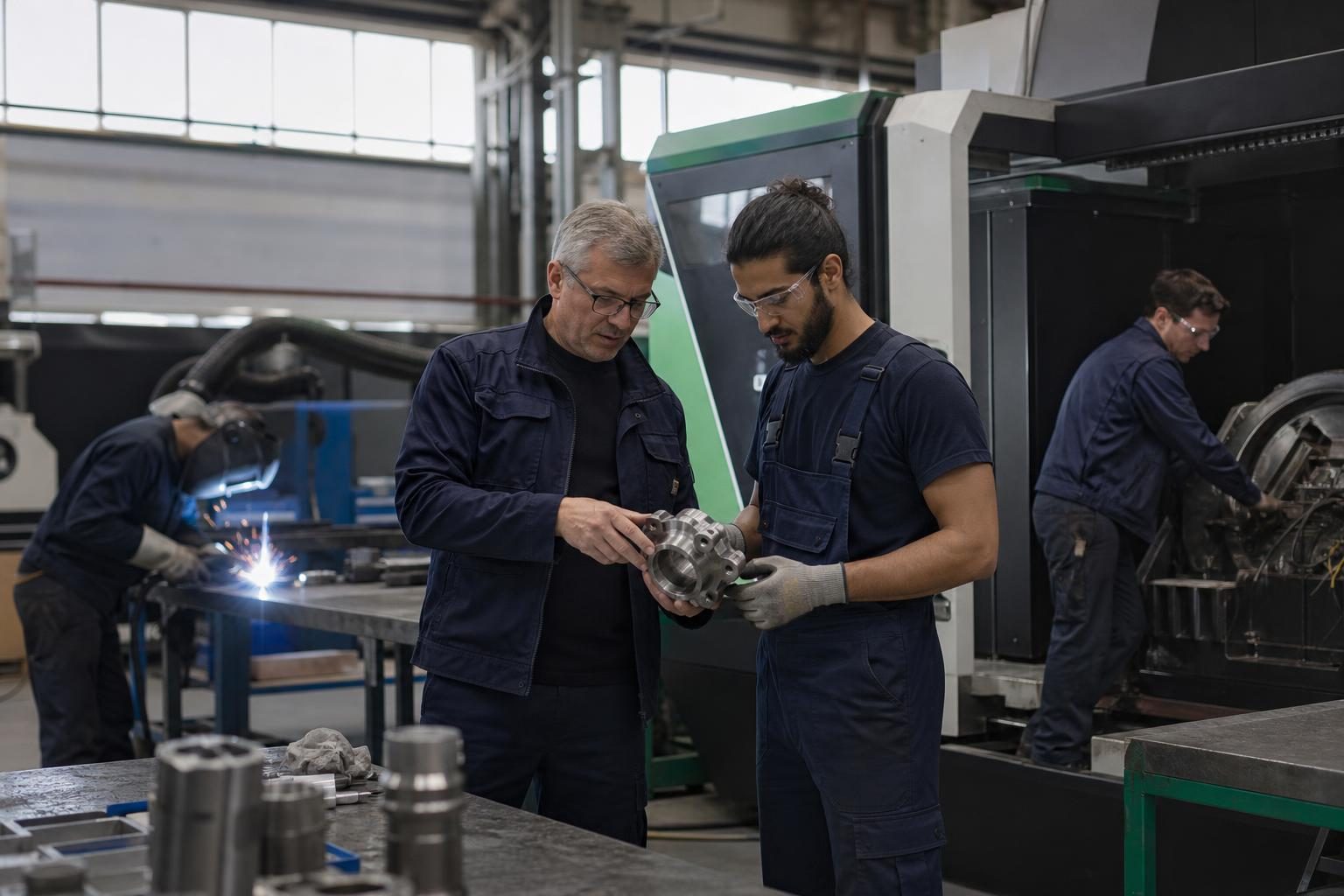
European manufacturers entering the final quarter of 2026 face a more complicated recruitment market than the phrase “factory worker shortage” suggests. Welders, CNC specialists, mechanical fitters and industrial maintenance technicians remain difficult to recruit in several important production markets, yet the pressure varies sharply by occupation, region and required skill level.
The latest evidence supports targeted cross-border recruitment—not indiscriminate hiring campaigns. Employers need to identify the exact process, machine and qualification gap before deciding where to search and whether relocation, training or immigration support is commercially realistic.
A cooler labour market has not removed specialist shortages
The European Labour Authority’s 2025 analysis recorded 2,617 occupational shortages and 2,177 surpluses across EURES countries. Professionals, trades workers and machine operators accounted for many reported shortages, while medium-level, occupation-specific skills were especially important. The report also found that migrants and mobile workers can ease shortages but are frequently overqualified or poorly matched to available work.[1]
At the same time, Europe is no longer experiencing the broad post-pandemic vacancy surge. Eurostat reported an EU job vacancy rate of 2.0% in the second quarter of 2026, down from 2.1% in both the previous quarter and the second quarter of 2025.[2] This whole-economy measure does not show that factory recruitment has become easy. It indicates that employers should distinguish a precise technical bottleneck from a general lack of applicants.
A shortage may exist for a TIG pipe welder, five-axis CNC programmer or fault-finding mechatronics technician while applicants remain available for basic assembly or machine-loading work. A broad job title can therefore produce many applications without producing a qualified shortlist.
Four manufacturing markets compared
| Market | Latest official signal | Roles relevant to factory recruitment | Practical interpretation |
|---|---|---|---|
| Austria | The nationwide 2026 shortage-occupation list includes several metal and mechanical categories.[3] | Welders and cutting-torch operators, mechanical-engineering technicians, specialist fitters, production and maintenance technicians, and several mechanical trades. | A strong target for qualified recruitment. Listed occupations may also be relevant to Austria’s shortage-occupation immigration route, but every candidate must satisfy the applicable job-offer, qualification, pay and points requirements. |
| Netherlands | UWV’s promising-occupations list for 2025–2026 contains an extensive industrial section.[4] | CNC machine operators, CNC machinists and programmers, welders, welding-robot operators, pipefitters, assembly mechanics, toolmakers and industrial machinery or mechatronics technicians. | Demand covers both production and higher-value maintenance skills. Employers should specify shift patterns, travel, housing and whether Dutch or English is required on the shop floor. |
| Poland | The 2026 Occupational Barometer identifies deficits affecting welders, machine mechanics and fitters, and machining occupations across multiple regions and provincial cities.[5] | Welders, machine mechanics and assemblers, metal-structure assemblers, CNC and other machine-tool operators. | Poland is both a recruitment market and a country with its own industrial shortages. Employers abroad should not assume that experienced Polish tradespeople are immediately available or willing to relocate. |
| Germany | The Federal Employment Agency identified 157 bottleneck occupations for 2025, down from 163 a year earlier. Machining was no longer classified as a nationwide bottleneck.[6] | Demand can remain difficult in particular technical specialisms, companies and regions, despite the changed national classification. | Recruit at regional and task level. A previous shortage label is not proof that every CNC or metalworking vacancy remains hard to fill throughout Germany. |
The comparison carries an important warning: manufacturing shortages are not interchangeable. Austria’s official list gives strong evidence for several mechanical trades, while the Dutch list reaches from welding and machining to mechatronics and production planning. Poland shows significant subnational deficits, whereas Germany demonstrates how a nationwide classification can ease even though individual factories still struggle.
Why conventional factory adverts fail
The occupation name is too broad
“Welder” does not explain the required process, material, position, thickness range, drawing standard or inspection environment. “CNC operator” may mean loading a proven programme, setting tools and offsets, or independently programming complex components. “Maintenance technician” can cover mechanical repairs, industrial electrics, programmable controllers, hydraulics or a combination of these skills.
International candidates must decide whether their experience transfers before investing in relocation. A vague advert shifts the screening burden onto applicants and recruiters, increasing unsuitable applications and late withdrawals.
The offer ignores the cost of mobility
A worker comparing local employment with relocation will look beyond the hourly or monthly wage. Relevant questions include:
- Are shift, night and weekend premiums stated separately?
- Is overtime guaranteed, optional or seasonal?
- What will housing, transport and utilities cost?
- Is the workplace reachable without a private car?
- Who pays for travel, skills tests and document translation?
- How long is the initial contract, and what happens during production slowdowns?
ELA identifies job quality, limited mobility and skills mismatches among the structural causes of European shortages.[1] Raising advertising volume without improving the employment proposition is unlikely to solve a recurring retention problem.
The selection process tests certificates rather than competence
Certificates can be important, but employers should establish what they actually prove and whether they are current and relevant to the vacancy. A structured assessment may combine document checks, a technical interview, interpretation of a drawing or fault scenario, and a safe practical test. The same criteria should be applied consistently to local and international applicants.
This approach follows the principles in our skills-first cross-border hiring playbook: define the work first, then separate essential competence from skills that can be taught after recruitment.
A practical recruitment plan for employers
- Build a role-specific skills matrix. Record processes, materials, machine controls, tolerances, maintenance systems, drawing knowledge, safety requirements and the level of independent decision-making expected.
- Check the location, not only the country. National shortage lists are useful signals, but regional demand, commuting distances and competing employers determine the real hiring difficulty. Poland’s forecast is explicitly built from local assessments, while Germany’s latest results show why old nationwide assumptions should be rechecked.[5][6]
- Separate mandatory and trainable criteria. Do not reject an experienced machinist solely because a previous employer used a different control system if conversion training is realistic. Conversely, do not treat basic machine operation as equivalent to independent setting and programming.
- Publish a complete employment package. State gross base pay, normal hours, shift premiums, overtime rules, contract duration, probation, holiday, workplace location and any deductions. If accommodation is offered, explain whether it is optional, its price, room arrangements, deposit and distance from the factory.
- Choose the mobility route before making promises. EU nationals generally do not need a work permit to work in another EU country. For non-EU nationals, the right to work depends on national immigration law and the person’s circumstances.[7] Austria’s shortage list, for example, does not itself grant permission to work; the candidate must qualify through the relevant procedure.[3]
- Use a proportionate technical assessment. Arrange remote screening before asking someone to travel. Tell candidates what will be tested, provide suitable protective equipment and never use an unpaid test as productive labour.
- Plan the first 90 days. Assign a trained supervisor, provide safety instructions in a language the worker understands, schedule technical and language support, and review housing and transport problems before they become resignations.
Employers testing specific markets can compare applicants through the available pages for jobs in Austria, jobs in the Netherlands, jobs in Poland and jobs in Germany.
What international candidates should verify
Factory specialists can improve their chances by presenting evidence at task level rather than listing only job titles. A useful application may identify welding processes and materials, CNC control families, machine types, production tolerances, maintenance responsibilities, drawings used and examples of faults resolved. References should be genuine and contactable, while confidential customer or factory information should not be shared.
- Ask what the role really involves. Confirm whether it is production operation, setting, programming, repair, installation or field service.
- Request the full pay structure. Compare guaranteed base earnings separately from overtime and shift additions.
- Check accommodation independently. Ask for the address or area, total deductions, room occupancy, transport options and notice conditions.
- Confirm work authorisation before travelling. EU free movement does not remove local residence, tax or social-security formalities, while non-EU candidates normally require an appropriate national route.[7]
- Keep control of original documents. Provide copies when reasonably required, but be cautious of recruiters demanding passports, advance placement payments or fees for a supposedly guaranteed permit.
Candidates exploring several destinations can review current jobs across Europe, but each vacancy should be assessed on its actual contract, location and skill requirements rather than the country’s general shortage status.
Conclusion: recruit for the bottleneck, not the headline
Late-2026 evidence shows continuing demand for industrial trades, particularly in Austria and the Netherlands, alongside significant regional shortages in Poland. Germany provides the necessary counterpoint: national bottleneck classifications can change as demand, unemployment and vacancies move.
The most effective response is a narrow one. Employers should identify the exact production constraint, verify the regional labour signal, advertise a transparent package, assess transferable competence and establish the correct mobility route before recruitment begins. Candidates should receive enough information to judge whether the work, pay and relocation are genuinely sustainable.
This article provides general labour-market and recruitment guidance, not legal advice. Employers and candidates must verify work-permit, employment, qualification, tax and social-security requirements for each individual case with the responsible authorities before signing a contract or arranging travel.
Sources and official references7 verified references
- Labour shortages and surpluses in Europe 2025
- Euro area job vacancy rate at 2.1%
- Austria-wide shortage occupations
- Kansrijke beroepen 2025–2026
- Barometr zawodów 2026: Raport podsumowujący badanie w Polsce
- Fachkräfteengpassanalyse 2025
- Work permits
Information reviewed 16 October 2026. Rules, statistics and labour-market conditions can change. Always confirm the latest requirements on the linked official websites. This article is general information, not legal advice.