
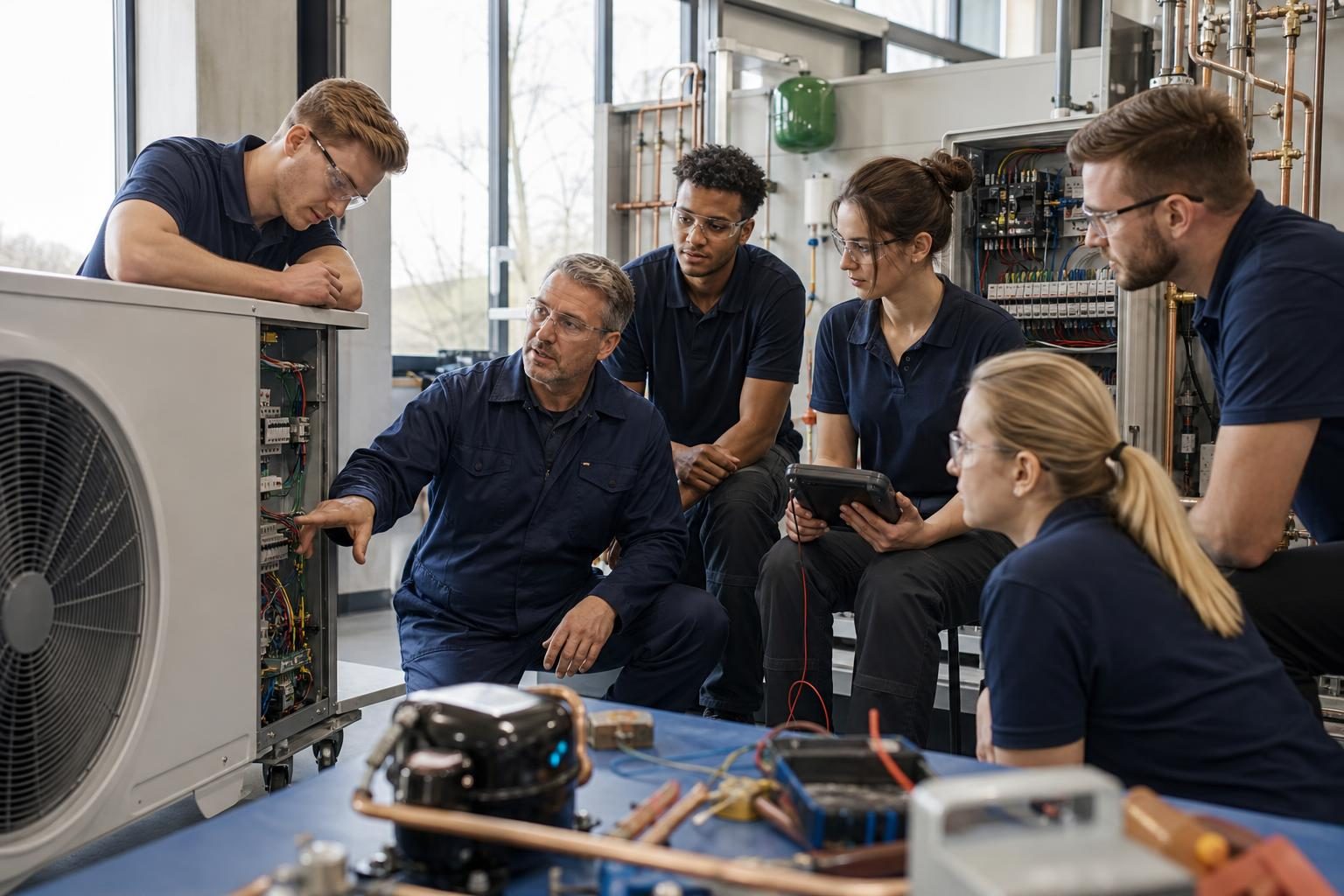
Europe’s clean-energy recruitment problem is increasingly a shortage of people who can install, connect, commission and maintain equipment—not simply a shortage of climate specialists. Electricians, heating and refrigeration installers, engineering technicians, welders, maintenance workers and site supervisors are being pursued by energy, construction, manufacturing and infrastructure employers at the same time.
For employers, the practical response is to recruit from adjacent trades and fund the final layer of technology-specific training. For candidates, the opportunity is substantial, but a familiar occupational title does not automatically prove that a qualification, safety certificate or right to work is valid in another country.
Why the clean-energy workforce has become a hiring priority
A September 2026 European Environment Agency assessment found that wind, solar photovoltaics, heat pumps and batteries already support hundreds of thousands of EU jobs. It also identified persistent technical skill shortages and low participation by women and younger workers as constraints on further growth.[1]
The pressure sits within a wider labour market mismatch. The European Labour Authority recorded 2,617 occupation-level shortages across EURES countries in 2025. Professionals, trades and machine operators were prominent, while shortage severity increased even though fewer occupations were in shortage across a majority of countries. Around 53 million people worked in occupations affected by widespread shortages or surpluses, indicating that Europe has both scarcity and underused labour at the same time.[2]
Clean-energy businesses are therefore competing for occupations that were difficult to recruit before the energy transition accelerated. The International Energy Agency reports that low career attractiveness, inaccessible training and weak alignment between energy policy and workforce planning are major barriers. Its analysis also stresses that employers need a combination of transferable competencies and technology-specific skills rather than an entirely new workforce for every technology.[3]
Four markets, four different recruitment needs
The figures below use the EEA’s comparable estimates of direct EU employment in 2023. They should not be treated as vacancy counts. The hiring priorities are a practical interpretation of the work required across each value chain.
| Technology | Estimated direct EU jobs, 2023 | Practical hiring focus | Main recruitment risk |
|---|---|---|---|
| Wind | 273,500 | Electrical and mechanical technicians, maintenance staff, engineers and site teams | Remote locations, work at height and competition for experienced technicians |
| Solar PV | More than 227,000 | Electricians, installers, roof workers, commissioning staff and site supervisors | Seasonal project peaks and confusion between rooftop and utility-scale experience |
| Heat pumps | About 80,100 | Heating, refrigeration and electrical workers with system-design and commissioning skills | Certification gaps and insufficient knowledge of new refrigerants |
| Batteries | About 33,000 | Mechatronics, production maintenance, process, quality and electrical specialists | Fast-changing processes and competition with automotive and advanced manufacturing |
The EEA found that Germany led absolute employment across wind, solar PV and batteries, while battery employment was growing particularly quickly in Hungary and Poland. Heat-pump employment was more prominent in Portugal, Spain and Italy.[1] Separate IRENA estimates put total EU renewable-energy employment at just under 1.8 million in 2024, including approximately 279,100 wind jobs and 764,400 solar PV jobs. Differences between studies reflect methodology and whether indirect, deployment or full-time-equivalent employment is included.[4]
Germany and the UK illustrate the competition for trades
Germany: a large market without a universal worker shortage
Germany’s scale makes it an important destination for mobile clean-energy workers, but employers should avoid describing every occupation as scarce. The Federal Employment Agency’s 2025 bottleneck analysis identified 157 shortage occupations, down from 163 a year earlier, and explicitly stated that there was no evidence of a general labour shortage. Shortages remained concentrated in areas including healthcare, construction and skilled crafts.[6]
That distinction matters. A solar contractor may struggle to recruit qualified electricians while still receiving many applications for general labouring posts. Employers should use occupation-level evidence, publish exact technical requirements and distinguish roles that genuinely need a fully qualified specialist from tasks that can be performed by supervised trainees. Candidates exploring jobs in Germany should likewise compare the advertised duties with their documented training rather than relying on the job title alone.
United Kingdom: strong projected growth in overlapping occupations
Skills England estimated that clean energy employed 232,000 people across the UK in 2025. Its 2026 assessment identified 31 priority occupations and projected that demand for those roles could increase by 63,000, or 71%, between 2025 and 2030. Twenty-eight of the priority occupations also appeared in at least one other major sector assessment, demonstrating how strongly clean energy competes with construction, manufacturing and infrastructure.[5]
The UK projection is not a confirmed vacancy total, and future demand depends on investment and delivery. It nevertheless gives employers recruiting for UK-based roles a clear warning: waiting for an experienced specialist who already holds every preferred credential may be slower and more expensive than converting a capable electrician, heating engineer or engineering technician.
Recruit occupations first and green specialisms second
A credible search should begin with the underlying occupation. “Renewable-energy technician” may be too broad to identify candidates, while “industrial electrician with inverter commissioning experience” or “refrigeration technician requiring heat-pump conversion training” gives recruiters something measurable.
Useful adjacent talent pools include:
- industrial and building electricians moving into solar, storage, charging or grid work;
- refrigeration, air-conditioning and heating technicians moving into heat pumps;
- mechanical maintenance workers moving into wind operations and maintenance;
- automotive mechatronics and process technicians moving into battery production;
- roofers and construction workers receiving tightly defined solar installation training;
- workers from conventional energy and heavy industry with relevant electrical, mechanical or safety experience.
This is an application of skills-first cross-border hiring: test what a candidate can safely do, identify the precise gap and build a documented route to competence. It does not mean lowering standards or placing an unqualified person in regulated work.
Qualification and certification checks must happen before travel
Legal requirement: where an occupation is regulated in the destination country, the worker may need formal recognition before practising. Regulation differs by country and occupation. Employers and candidates should check the EU regulated-professions database and contact the destination country’s competent authority or national assistance centre rather than assuming that an electrician’s or technician’s status transfers automatically.[7]
Heat-pump recruitment may also involve EU rules on refrigerants. Commission Implementing Regulation (EU) 2024/2215 sets minimum requirements for certificates covering stationary refrigeration, air-conditioning and heat-pump equipment, including equipment using fluorinated gases or relevant alternatives. It provides for recognition of certificates issued in other Member States, although a translation may be requested, and requires holders of older certificate categories to update their knowledge and skills to the new certificate level.[8]
Practical guidance: build a pre-employment document pack containing the qualification, transcript or training syllabus, employment references, certificate number, issuing authority, expiry or refresher status and certified translation where needed. Separately verify immigration status, driving entitlement, electrical authorisations, site cards and occupational-safety training under the destination country’s rules.
Safety cannot be treated as a short induction added after recruitment. EU-OSHA notes that green technologies can combine established hazards in unfamiliar ways—for example, solar installation can require roofing, plumbing and electrical competence—and rapid expansion can place inexperienced workers into tasks for which they have not been properly trained.[9]
A practical plan for employers
- Break the role into tasks. List installation, wiring, refrigerant handling, commissioning, diagnostics, maintenance, reporting, travel and supervision separately.
- Mark every mandatory condition. Separate legal qualifications, certificates and work authorisation from desirable manufacturer experience.
- Recruit from adjacent occupations. Search by core trade, equipment and diagnostic skill rather than using only a fashionable green job title.
- Use practical assessment. Test drawing interpretation, fault finding, safe isolation, measurement and problem-solving in a controlled setting.
- Offer a paid conversion route. State who pays for training, assessment, translation and certification, and whether training time is paid.
- Plan supervision capacity. A large trainee intake fails if experienced workers do not have scheduled time to coach and sign off competence.
- Compete on job quality. Publish pay, overtime, travel, rotation, accommodation, tools, weather exposure and contract duration clearly.
- Retain through progression. Show how an installer can progress into commissioning, maintenance, supervision or technical support.
Employers using the wider European jobs market should also map recruitment by project location. A national talent pool may not solve a shortage on an island, rural retrofit programme or remote wind site unless transport, accommodation and predictable rotations are addressed.
What international candidates should check
- Ask for the exact daily tasks, equipment types and working environment.
- Confirm whether the occupation or particular activity is regulated at the destination.
- Verify who pays for recognition, translations, examinations and refresher training.
- Do not describe general electrical or plumbing experience as specialist commissioning experience.
- Request written details of pay, guaranteed hours, overtime, travel time, accommodation deductions and probation.
- Check whether the employer provides tools, protective equipment and supervised training.
- Keep copies of qualifications, course content, references and safety records before travelling.
Candidates should treat short technical courses as additions to a trade foundation, not automatic proof that they can perform every part of a regulated or safety-critical role independently.
Conclusion: build talent instead of waiting for it
Europe’s clean-energy workforce gap cannot be solved by moving the same limited group of experienced specialists between employers. The more durable model is to identify transferable trades, verify legal access to the work, assess practical competence and finance the final conversion into wind, solar, heat-pump or battery roles.
Employers that combine transparent conditions with paid training and credible progression will have a stronger proposition than those advertising a long list of credentials for short, uncertain projects. Candidates who document their core trade and close specific certification gaps will be better placed to move safely across sectors and borders. Requirements vary by occupation and country, so every case should be verified with the linked competent authority; this article provides general labour-market guidance, not legal advice.
Sources and official references9 verified references
- Clean energy technologies in the European Union — Implications for quality jobs, skills and a just transition
- Labour shortages and surpluses in Europe 2025
- Ensuring a Skilled Renewable Energy and Energy Efficiency Workforce
- Renewable Energy and Jobs: Annual Review 2025
- Sector Skills Needs Assessment – Clean Energy
- Fachkräfteengpassanalyse 2025
- Recognition of qualifications: European professional card
- Commission Implementing Regulation (EU) 2024/2215 on certification for refrigeration, air-conditioning and heat-pump equipment
- Workers’ safety and health in green jobs
Information reviewed 9 October 2026. Rules, statistics and labour-market conditions can change. Always confirm the latest requirements on the linked official websites. This article is general information, not legal advice.