
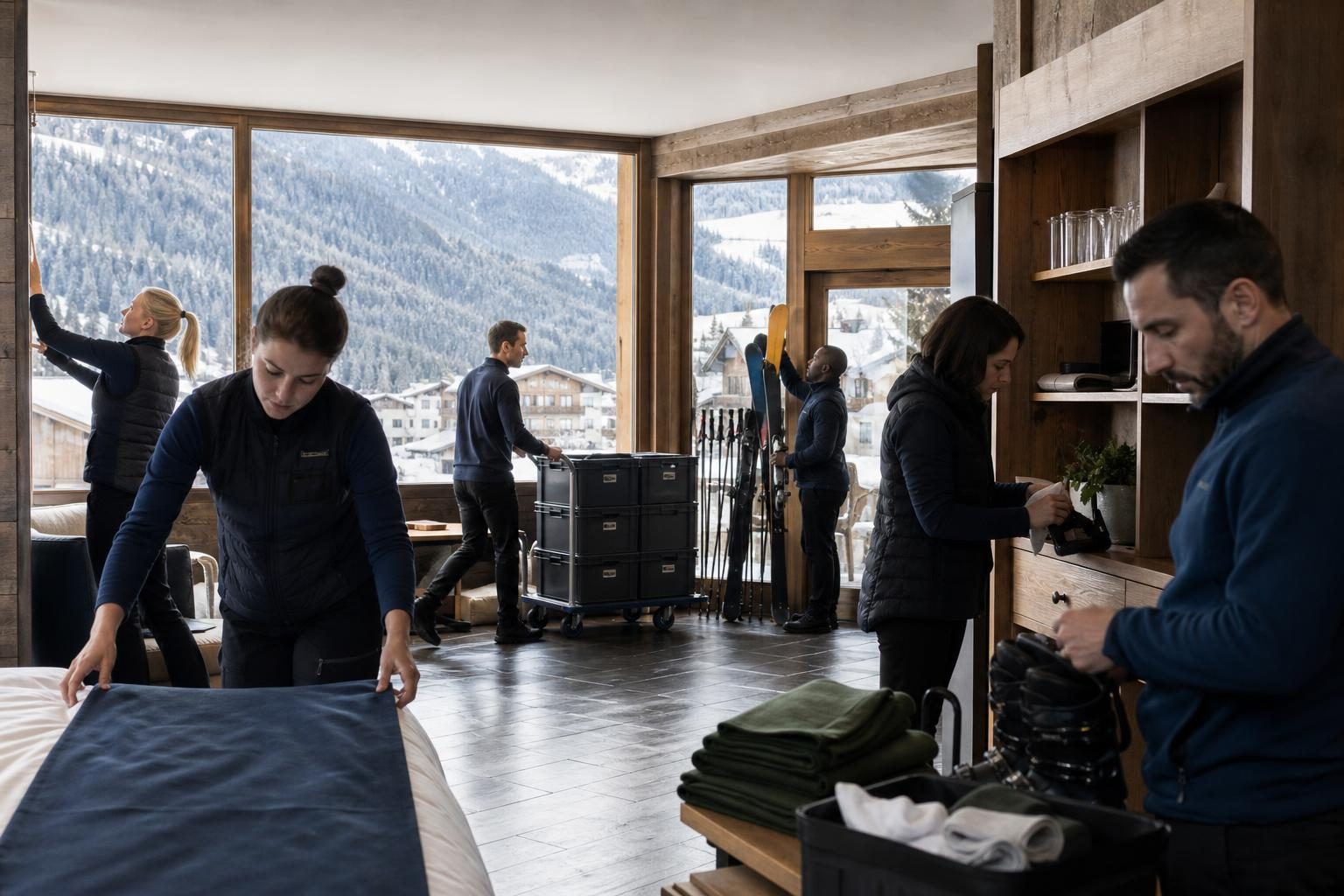
Recruitment for the 2026/27 Alpine winter season is moving into its decisive period. Hotels, restaurants and resorts need cooks, service staff, housekeepers, cleaners and maintenance workers, but candidates should compare more than the headline wage. Contract hours, staff housing, permit eligibility and the treatment of vocational qualifications can change the real value of an offer.
Hospitality shortages remain a cross-border issue. The European Labour Authority found that cooks, chefs and waiters were reported as shortage occupations in numerous European countries, while mobile workers represented a much larger share of hospitality employment than of the wider EU economy.[1] This guide compares Austria, France and Switzerland using rules and wage figures available on 29 September 2026.
Quick comparison for the 2026/27 winter season
| Country | Illustrative statutory or collective floor | Typical access for EU/EEA candidates | Main check before accepting |
|---|---|---|---|
| Austria | Tyrol helper: €2,026 gross monthly until 30 September 2026; €2,096.50 from 1 October | Free access for EEA and Swiss citizens | Correct wage group and written housing cost |
| France | €12.31 gross per hour from 1 June 2026 | Free movement for EU/EEA and Swiss citizens | Applicable collective agreement and actual guaranteed hours |
| Switzerland | CHF3,713 gross monthly for an untrained adult hospitality worker in 2026 | Simplified access for EU/EFTA citizens, with notification or residence formalities | Health insurance, housing deduction and weekly hours |
These are gross reference floors, not estimates of take-home pay. They are not directly comparable because currencies, taxes, social insurance, working-time systems and accommodation arrangements differ.
Austria: structured wage groups and widespread staff housing
Austria is a major destination for Polish and other European winter workers, particularly in Tyrol and Salzburg. Candidates can review current opportunities through jobs in Austria, but every offer should identify the collective-agreement wage group rather than merely promising “Austrian rates”.
Pay changes on 1 October 2026
Austria’s hotel and restaurant wage tables classify workers by responsibility, recognised training and sector experience. In Tyrol, a helper with fewer than ten years of hospitality experience is currently entitled to at least €2,026 gross monthly in the first seniority band. A qualified cook or restaurant professional in wage group 3 currently starts at €2,165.[2]
These are the current rates on 29 September 2026. A confirmed collective-agreement increase takes effect on 1 October 2026. From that date, the corresponding Tyrol minima rise to €2,096.50 for a helper and €2,232 for a qualified worker. More responsible chef de partie, chef de rang and supervisory roles can fall into higher groups.[3] Candidates beginning work in October should therefore ensure that the contract or first payslip uses the new table, not the rate expiring on 30 September.
Permits and accommodation
EEA and Swiss citizens may work in Austria under the same labour-market conditions as Austrian citizens, although address registration and, for stays exceeding three months, residence-registration formalities still apply. For third-country nationals recruited as seasonal workers, the employer applies to the Austrian Public Employment Service for a quota permit. Approval depends on an available quota place, a labour-market test, compliant employment conditions and evidence of locally customary accommodation. Seasonal quota permits normally last up to six months, with seasonal employment generally limited to nine months in a twelve-month period.[4]
Employer-provided sleeping rooms must meet Austrian workplace accommodation standards, including requirements concerning windows, heating, lockability, room height, furniture and available space.[5] Practical checks should go further:
- Ask for the exact monthly rent and any deposit before travelling.
- Confirm whether meals, utilities, laundry and local transport are charged separately.
- Ask whether the room is private or shared and how many people use the bathroom.
- Check the distance to work, especially where late shifts end after public transport stops.
France: hourly clarity, but guaranteed hours matter
French Alpine resorts recruit for hotels, restaurants, chalets, cleaning operations and guest services. Candidates can monitor jobs in France, but should distinguish the legal minimum from a role-specific rate under the relevant collective agreement.
Pay and seasonal contracts
France’s gross hourly minimum wage has been €12.31 since 1 June 2026, equivalent to €1,867.02 gross monthly on the standard 35-hour basis. A collective agreement may require a higher rate. Meals or accommodation supplied as benefits in kind may also be reflected on the payslip within the applicable rules.[6]
A higher hourly rate does not automatically make an offer better. Candidates should ask how many hours are contractually guaranteed, how overtime is authorised and paid, and whether split shifts are expected. French seasonal fixed-term contracts do not normally carry the standard end-of-contract precariousness payment, although more favourable collective arrangements may apply.[6]
Non-EU seasonal access
EU, EEA and Swiss citizens generally do not require a work permit. A third-country national recruited from abroad normally needs the employer to obtain work authorisation before the visa process. France’s seasonal-worker route allows employment linked to activities such as tourism, but limits foreign seasonal work to six months in any rolling twelve-month period. Each new employer must obtain the required authorisation.[7]
Do not travel on the assumption that a tourist entry permits employment. The employer should be able to identify the authorisation requested, the contract dates and the visa or residence procedure applicable to the candidate’s nationality.
Staff housing in French resorts
Accommodation can determine whether a French resort wage is workable. Where employers provide collective housing to fixed-term seasonal staff, national rules address matters including heating, potable water, sanitation, sleeping-room capacity and minimum space. Official guidance states that sleeping accommodation may house no more than six workers and generally requires at least six square metres per occupant; bunk beds are not permitted under the rules described by the Labour Ministry.[8]
Before accepting, request photographs or a video call, the full address, occupancy level and written rent. Clarify what happens to the room if the contract ends early. Housing tied to employment may have to be vacated quickly, so candidates should retain emergency funds and a return-travel plan.
Switzerland: higher gross pay, higher entry barriers and costs
Switzerland offers the highest nominal wage in this comparison, but it also has expensive housing, compulsory health insurance and stricter access for non-EU/EFTA nationals. Relevant vacancies may appear among jobs in Switzerland.
Hospitality wage floors in 2026
Under the national hospitality collective agreement, the 2026 gross monthly minimum for a full-time adult employee without an apprenticeship is CHF3,713. A worker with an equivalent two-year vocational qualification has a minimum of CHF4,070, while a recognised full vocational qualification raises the reference minimum to CHF4,528. A written introductory reduction of up to 8% can be permitted in specified wage categories and circumstances, so candidates should read this clause carefully.[9]
Seasonal establishments may use an average working week of up to 43.5 hours under the collective agreement, compared with 42 hours in other standard establishments. Overtime must be compensated with time off or pay under the applicable conditions.[10] This is why comparing only monthly salaries can be misleading.
Permits and health insurance
EU/EFTA citizens working for a Swiss employer for up to three months generally use the notification procedure. Longer employment requires registration and a residence permit linked to the contract duration. Workers must also arrange compulsory Swiss health insurance no later than three months after arriving or beginning work, unless a recognised exception applies.[11]
For most third-country nationals, an ordinary entry-level winter hospitality job is not a realistic Swiss immigration route. Admission is generally limited to managers, specialists and other highly qualified professionals, and the employer must demonstrate that no suitable worker could be recruited in Switzerland or the EU/EFTA area.[12]
Qualification and document checks for candidates
Many housekeeping, cleaning, kitchen-assistant and basic service jobs are recruited on experience and language ability rather than formal recognition. However, certificates can directly affect classification and pay, particularly for trained cooks and hospitality professionals in Austria and Switzerland.
- Bring the original diploma or vocational certificate and a clear scan.
- Prepare employment references showing duties, dates and responsibility levels.
- Ask whether a certified translation is required.
- Request written confirmation of the wage group before departure.
- For regulated activities such as ski instruction, healthcare, childcare or certain technical work, check the profession-specific recognition and licensing authority separately.
A European residence permit does not automatically give a third-country national the right to work in every other country. Citizenship, residence status, contract duration and the destination’s rules must all be checked.
What employers should do before winter arrivals
Resorts competing for mobile workers should treat accommodation and documentation as retention tools, not last-minute administration.
- Publish the gross rate and classification: identify the collective agreement, wage group, normal hours and overtime method.
- Describe housing honestly: state rent, deductions, occupancy, facilities, distance and move-out rules.
- Complete permits before travel: never encourage a candidate to begin work while an authorisation is unresolved.
- Recognise evidence consistently: give candidates a process for submitting diplomas and experience records.
- Provide accessible onboarding: explain time recording, payslips, safety, complaint routes and who to contact about housing.
Employers planning repeated seasonal recruitment may also benefit from the retention lessons in the guide to Nordic seasonal hiring in 2026.
Practical conclusion
Austria offers clear vocational wage groups and a well-established seasonal accommodation model. France provides a transparent national hourly floor, but candidates must examine guaranteed hours and housing costs. Switzerland has much higher nominal pay, yet longer working-time references, compulsory insurance and restricted third-country access can materially change the comparison.
Before booking travel, obtain a signed contract, permit confirmation where required, the housing terms and the correct wage classification. Candidates wanting a wider search can review current jobs across Europe. Rules can vary by nationality, canton, region, collective agreement and individual role, so every worker and employer should verify the case with the linked authority. This article provides general information, not legal advice.
Sources and official references12 verified references
- Accommodation and food service activities: issues and challenges related to labour mobility
- Lohnordnung Gastronomie und Hotellerie Tirol, Arbeiter/innen, gültig ab 1.5.2025
- Lohnordnung Gastronomie und Hotellerie Tirol, Arbeiter/innen, gültig ab 1.10.2026
- Seasonal Workers
- Kommentierte Arbeitsstättenverordnung – Section 37, living rooms
- Emploi saisonnier : vos droits, vos démarches, tout ce qu'il faut savoir
- Salaried employment – Seasonal worker
- Posted workers' rights – collective accommodation requirements
- Salaires minimums 2026 – Convention collective nationale de travail pour les hôtels, restaurants et cafés
- Art. 15 Durée du travail / heures supplémentaires
- Working in Switzerland as a foreign national
- Non-EU/EFTA nationals
Information reviewed 29 September 2026. Rules, statistics and labour-market conditions can change. Always confirm the latest requirements on the linked official websites. This article is general information, not legal advice.